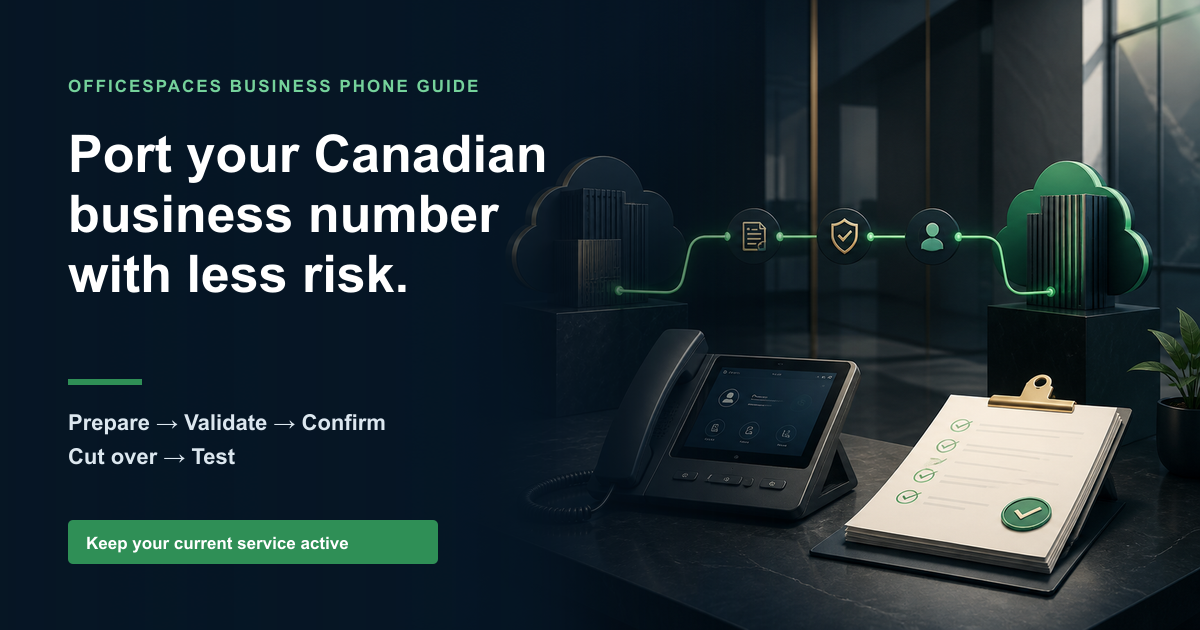
Number porting moves an existing telephone number from one provider to another. It is not simply an account cancellation, and it does not automatically move every feature, device, message history or bundled service attached to the old account. The CRTC explains that customers may be able to switch providers and keep their number, subject to eligibility and the applicable transfer process.
Can a Canadian business keep its existing phone number?
Often, but not always. Eligibility can depend on whether the number is active, the local exchange or rate centre, the old and new service areas, carrier support, account condition, number type and the service being used. Local landline, wireless, VoIP and toll-free numbers do not necessarily follow identical workflows.
The CRTC’s local number portability overview notes that a customer generally needs to remain within the same exchange area to retain a local wireline number. Transfers between VoIP, wireline and wireless services can have different technical or geographic limits, and a new number may be required in some circumstances. The receiving provider should check the exact number before a business schedules a cutover.
Portability also does not settle contractual questions. Review outstanding balances, minimum terms, equipment returns, early-cancellation terms and bundled Internet or other services separately. This guide is operational information, not legal advice or an interpretation of a service contract.
What documents are needed to port a business number?
Collect the records before choosing a date. A recent complete bill is useful, but some providers may request a customer service record, Letter of Authorization or service-specific evidence. Copy values exactly; abbreviations and punctuation that look harmless to a person can still cause an automated mismatch.
Printable business number-porting checklist
- A recent complete bill or invoice and, where available, the carrier’s customer service record.
- The exact legal, business or account-holder name shown by the current carrier.
- The service address and billing address exactly as recorded—not only the office’s current mailing address.
- Every applicable account number, the current carrier and each telephone number requested for porting.
- The authorized contact or signatory and their current, monitored contact details.
- A PIN or password only when securely requested through an approved carrier workflow. Never publish it or send it in ordinary email unless the carrier’s process explicitly protects it.
- A signed Letter of Authorization when required, with names, dates and numbers matching the account records.
- A line-by-line list of numbers to port, retain or disconnect, including main, billing telephone number (BTN), pilot and secondary-number relationships.
- Current hunt groups, call forwarding, fax, alarm, elevator, intercom, payment-terminal and other line dependencies.
- The preferred cutover window plus onsite and remote testing contacts who can act during that window.
- A review of contracts, balances, leased equipment, returns and services bundled with the line.
How does carrier validation work?
The exact workflow varies, but a typical business port has five operational stages:
- PrepareInventory numbers, dependencies and matching account records.
- ValidateThe receiving provider checks eligibility and submits customer authorization.
- ConfirmThe losing carrier validates the request and carriers establish an accepted due date.
- Cut overRouting and the new service are activated in the coordinated window.
- TestThe business verifies calls, messaging, routing, users and billing.
The receiving provider collects authorization and account data, checks whether it can support the number, and submits a request through the applicable carrier process. The losing carrier validates the account holder, number, address, account status and authorization. If accepted, the providers coordinate a due date or activation window. OfficeSpaces cannot control the losing carrier, override a carrier rejection or guarantee retention of a number.
In Telecom Decision 2026-185, the CRTC addressed confirmation before a switch is provisioned and before a local number portability subscription is created in NPAC. In practical terms, the new provider should have confirmation of the customer’s local service request before provisioning the switch or creating that subscription. This safeguard does not eliminate the need for accurate records or carrier acceptance.
Why do Canadian business number ports get rejected?
Rejection codes and correction processes vary by carrier and number type. Common causes include:
- The legal name, service address, account number or BTN does not exactly match the carrier record.
- The number is inactive, disconnected, suspended, frozen or otherwise unavailable for transfer.
- The requester is not an authorized account contact, or a required PIN is wrong.
- A Letter of Authorization is missing, incomplete, expired or inconsistent with the request.
- The receiving provider cannot support the number type, rate centre, exchange or service area.
- A pending order, account freeze, duplicate request or conflicting requested date exists.
- A partial port would strand dependent numbers or features in a hunt group, bundle or billing relationship.
- An applicable carrier or account condition, including a balance issue where relevant to that process, has not been resolved.
Do not guess at a rejected field and resubmit repeatedly. Ask the receiving provider for the exact rejection reason, correct only the requested data, and confirm whether a new authorization or date is required.
What happens during the phone-number transfer?
Before activation, the receiving provider may configure users, business hours, menus, voicemail and routing in its system. After carrier confirmation, routing changes are scheduled and the old provider releases the number through the applicable process. Routing can propagate across networks at different speeds, so inbound calls from one network may behave differently from another for a period.
Temporary issues can affect inbound or outbound calls, caller ID, SMS or MMS, voicemail, fax, routing and emergency-calling configuration. Messaging eligibility does not automatically follow voice portability. Ask whether messaging needs separate registration or activation. For VoIP service, review VoIP 9-1-1 limitations and customer responsibilities before cutover.
There is no universal sequence or guaranteed completion time for every carrier. Consumer examples should not be treated as a commitment for business, VoIP, toll-free, multi-number or complex ports. The receiving carrier’s accepted schedule and current status control.
How should a business prepare for port day?
| Before | During | After |
|---|---|---|
| Export contacts and required voicemail; document routing, users and dependencies. | Staff a test team and keep carrier escalation contacts available. | Test from multiple networks and document results, times and ticket numbers. |
| Tell customers and teams about the maintenance window and approved backup channel. | Keep old devices, accounts and services accessible; avoid unrelated changes. | Confirm completion in writing before considering old-service changes. |
| Arrange a temporary number or forwarding only when carrier-approved. | Use backup email, mobile or web channels if the primary route is affected. | Audit bills, bundles, equipment and remaining dependent services separately. |
What should be tested after the port?
- Inbound calls from more than one mobile, landline or VoIP network where practical.
- Outbound calls and the caller ID shown to recipients.
- SMS and MMS only where the number and intended use are eligible.
- Voicemail, greetings, call queues, IVR menus, forwarding, business hours and after-hours routes.
- Fax or other legacy functions only where the new service specifically supports them.
- User apps, desk phones, permissions, recordings and shared-number behaviour.
- Emergency-calling configuration and the registered service address using the provider’s approved verification process—do not place an unnecessary test call to 9-1-1.
- The new bill, taxes, usage charges and any remaining old-provider invoice.
What should not be cancelled after the number moves?
Port completion and termination of every old-provider service are not necessarily the same event. A line may support Internet, alarms, elevator communication, fax, door entry, payment terminals or a billing relationship for other numbers. Audit each dependency before cancelling a bundle, returning hardware or powering down equipment.
Review contracts and balances independently. If the old invoice remains open after the number moves, ask the provider what services and charges remain rather than assuming the port closed the whole account. Consult the relevant agreement and the OfficeSpaces terms of use where applicable.
What should you do if a port is rejected or delayed?
- Keep the current service active. Do not cancel while the rejection or delay is being investigated.
- Get the exact reason. Ask the receiving provider for the carrier response and the field or dependency that needs correction.
- Correct carefully. Change only requested information and avoid duplicate requests unless instructed.
- Keep an audit trail. Record dates, contacts, authorization versions, request identifiers and promised follow-ups.
- Escalate through the provider. Use the receiving provider’s porting or carrier-escalation contact first.
The CRTC publishes telephone complaint guidance. After giving the provider a reasonable opportunity to resolve an issue, qualifying consumer or small-business complaints may fall within the Commission for Complaints for Telecom-television Services process. Confirm current eligibility and jurisdiction; this guide does not assert that every porting dispute qualifies.
What should you ask OfficeSpaces or any receiving provider?
- Is each number eligible for the requested service, location and number type?
- Which documents are required, and what secure channel should be used for sensitive information?
- What is the target cutover window, and which parts are estimates rather than guarantees?
- What continuity option is carrier-approved if routing is temporarily affected?
- Will SMS, MMS, fax and emergency calling require separate validation or configuration?
- How will partial ports affect BTNs, hunt groups, bundles and dependent lines?
- Who is the live escalation contact, and what constitutes confirmed completion?
Review the OfficeSpaces virtual phone system, explore the phone-system demonstration, read the CRTC BITS licence guide, or use the support guide for related information. Illustrative product pages do not confirm that a particular number is portable.
Frequently asked questions
Should I cancel my current phone service before porting?
No. Keep it active until the receiving provider confirms completion. Cancelling early can make the number unavailable or interrupt service.
How long does a Canadian business number port take?
There is no single reliable timeline. Service type, carrier validation, number quantity, dependencies and corrections affect the schedule. Use the receiving carrier’s confirmed window, not a generic estimate.
Can I keep the number after moving to another city or province?
Not always. Local numbers may depend on the exchange, rate centre or service area. Ask the receiving provider to validate the exact number and destination.
Can a landline or wireless number move to VoIP?
It may be eligible, but service-type and geographic restrictions can apply. Some transfers may require a new number according to the available carrier process.
What should I do after a rejection?
Request the exact rejection reason, compare it with carrier records, correct only the requested fields and avoid duplicate submissions.
Will SMS automatically work after a voice port?
No. Messaging can require separate activation, registration, consent controls and number-type eligibility. Confirm before relying on it.
Can a provider guarantee no downtime?
No. Careful preparation and testing reduce risk, but carrier routing and account dependencies mean a disruption-free transfer cannot be guaranteed.
When can I remove old phones or equipment?
Only after the receiving provider confirms completion, testing succeeds and the business audits any Internet, alarm, fax, elevator, terminal or bundle dependency.
Does porting end billing with the old provider?
Not necessarily. Contracts, remaining services, equipment and billing cycles are separate. Review the old account and agreement directly.
Sources and review notes
- CRTC: Switch providers and keep your number
- CRTC: Local number portability overview
- CRTC Telecom Regulatory Policy 2017-11: customer-transfer obligations
- CRTC Telecom Decision 2026-185: confirmation before switch provisioning and NPAC subscription
- CRTC: Telephone complaint guidance
- Canadian Numbering Administrator: Canadian numbering context
Reviewed: August 30, 2026 by the Office Spaces Editorial Team. Carrier processes, eligibility rules and regulatory guidance can change. Confirm the receiving provider’s current requirements before relying on this guide. To request a correction, email info@officespaces.co.